Remote vehicle hacks are up 225% year-over-year. This isn't hypothetical, vehicles are being remotely unlocked, disabled and tracked by exploiting security holes.
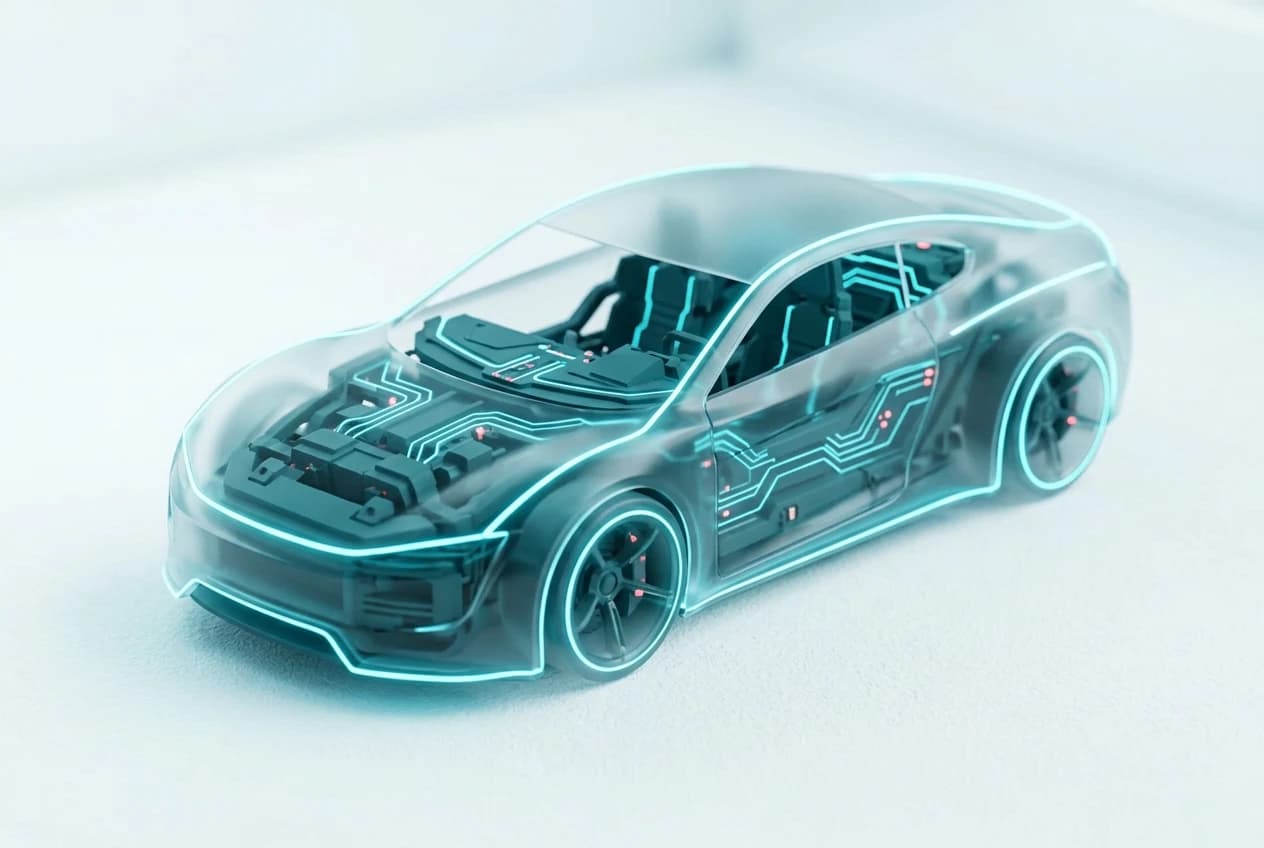
Modern cars contain over 100 electronic control units (ECUs), run on over 100 million lines of code and maintain 15+ external connectivity points ranging from cellular modems to Bluetooth, Wi-Fi and vehicle-to-everything (V2X) communication. This connectivity powers features like OTA updates and ADAS, but it also creates massive attack surfaces.
If you're securing OTA updates, protecting IP, or preventing cyber attacks on vehicles, you need layered security across hardware, software, networks and cloud.
Here's what works in 2026.
What Are Automotive Security Solutions?
Automotive security solutions protect vehicles from cyber and physical threats throughout their lifecycle. This includes secure boot processes, real-time intrusion detection, encrypted OTA updates and more.
The difference from IT security: in cars, security failures can kill people. A compromised brake ECU isn't just a data breach, it's a safety incident. This is why automotive security regulations are mandatory, not optional.
UN Regulation 155 requires cybersecurity management systems for vehicles sold in Europe, Japan, Korea and other markets. ISO/SAE 21434 is the engineering standard. You need both to sell cars in major markets.
Different stakeholders face different problems. OEMs protect billions in IP and manage brand risk. Suppliers need to prove security to win contracts. Fleet operators need real-time threat monitoring across thousands of vehicles. Even consumers now check security features before buying.
The Threat Landscape in 2026
Remote Attacks
Keyless entry systems get hacked through relay attacks that extend key fob signals. Thieves unlock and start cars parked hundreds of meters from the actual key.
CAN bus attacks are worse. The Controller Area Network from the 1980s has zero built-in security. Once attackers access the CAN bus, through a compromised infotainment system or OBD-II port, they can inject messages controlling critical functions. CAN remains the biggest internal vulnerability.
V2X adds new vectors. Fake messages about road conditions, phantom vehicles, or traffic signals could cause accidents.
Physical Threats
Modern thieves combine cyber and physical methods. They exploit OBD-II ports to reprogram computers and bypass immobilizers. Organized groups target high-value components: catalytic converters, sensors, modules that can be resold or counterfeited.
Supply Chain
Over 60% of vehicle code comes from third parties. That's 60% you don't directly control. Malicious code can enter during manufacturing, development, or shipment. The SolarWinds attack proved that sophisticated attackers target supply chains, not end products.
OTA Manipulation
OTA updates will be in 350+ million vehicles by 2026. If attackers intercept or inject malicious updates, they can compromise entire fleets at once. OTA security is critical infrastructure.
IP Theft
The software and algorithms running ADAS and autonomous systems represent billions in R&D. Reverse engineering, insider threats and remote extraction are real risks. Hardware security modules (HSMs) are mandatory for protecting this IP.
Real Incidents
Researchers have demonstrated remote vehicle control through entertainment system hacks, triggering recalls of millions of vehicles. The average automotive recall costs over $300 million. More importantly, these incidents destroy consumer trust.
Regulations
UN R155 and R156 (effective 2022-2024) mandate cybersecurity management and secure software updates. These aren't guidelines, they're legal requirements for type approval in major markets.
GDPR applies to vehicles collecting location history, driving behavior, biometric data and audio/video from cabin cameras. Security breaches exposing this data trigger privacy law penalties on top of automotive consequences.
Types of Security Solutions
No single technology fixes everything. You need multiple categories working together.
1. Cybersecurity Solutions
In-vehicle network security protects CAN buses and Automotive Ethernet networks connecting ECUs. Modern gateway ECUs act as firewalls between network domains, preventing unauthorized communication between safety-critical and less secure systems.
Intrusion detection systems (IDPS) monitor network traffic and ECU behavior for anomalies indicating attacks. They must work in real-time with minimal latency, delayed detection on safety systems has immediate consequences. Machine learning establishes baseline behavior and flags deviations.
SIEM for automotive aggregates security data across fleets, correlates events and provides centralized monitoring. This fleet-level visibility detects attack campaigns targeting multiple vehicles.
Endpoint protection hardens ECUs by disabling unnecessary services, implementing least-privilege access and checking runtime integrity to verify critical software hasn't been modified.
SOC services provide 24/7 monitoring and threat response. For OEMs and large fleets, dedicated automotive SOCs with specialists who understand vehicle-specific threats are becoming standard.
2. OTA Security
Secure architecture starts with encrypted channels protecting update packages during transmission. But encryption alone doesn't work, you need authentication to verify updates come from legitimate sources and aren't tampered with.
Code signing uses cryptographic signatures to ensure authenticity. Vehicles verify signatures against trusted certificates before installing anything. This blocks malicious or unauthorized software.
Rollback protection prevents downgrading to older versions with known vulnerabilities. The system tracks versions and refuses older software unless explicitly authorized.
Leading OTA platforms integrate encryption, signing, rollback protection and multi-factor authentication into complete lifecycle management from creation through verified deployment. DuoKey's secure OTA solutions provide end-to-end protection for automotive update systems.
3. IP Security
Hardware security modules (HSMs) provide tamper-resistant environments for cryptographic operations and secure key storage. Automotive-grade HSMs meet extreme temperature, vibration and longevity requirements while providing hardware-enforced security.
Secure boot ensures only authenticated software executes on ECUs. During startup, each component cryptographically verifies the next before transferring control, creating a chain of trust from hardware to applications.
Trusted execution environments (TEEs) create isolated processing areas where sensitive operations run protected from other software. Security-critical functions remain protected even if other components are compromised.
Anti-reverse engineering includes code obfuscation, white-box cryptography and runtime integrity checks that make it harder to analyze proprietary algorithms.
Key management systems handle the complete lifecycle: generation, distribution, storage, rotation and revocation. Poor key management breaks otherwise sound cryptography.
4. V2X Security
V2X requires complete PKI managing millions of certificates. Each vehicle needs multiple certificates that rotate regularly to prevent tracking while maintaining message authenticity. The V2X PKI must issue, distribute and manage certificates at massive scale.
Certificate management handles enrollment, provisioning, renewal, revocation and distribution of revocation lists. Performance requirements are tight, vehicles must verify authenticity within milliseconds for real-time communication.
Misbehavior detection analyzes V2X messages to identify malicious communications. If a vehicle consistently sends messages conflicting with sensor data or other vehicles' reports, the system flags it and potentially revokes certificates.
5. Physical Security
Modern immobilizers integrate with vehicle-wide security systems. Advanced alarms incorporate interior monitoring, tilt sensors detecting towing and telematics integration for remote alerts.
GPS tracking provides fleet management beyond theft recovery: geofencing, driver monitoring, usage analytics. Security comes from redundant communication and tamper alerts.
Biometric authentication (fingerprints, facial recognition, voice) adds strong authentication beyond keys or fobs. Implementation must balance security with usability, drivers won't accept systems that frequently fail or take too long.
Tamper-evident hardware makes physical attacks harder and detectable: epoxy coating on sensitive chips, mesh layers that break if someone decaps components, sensors detecting abnormal environmental conditions.
What Makes Security Solutions Actually Work
Real-time detection and response is mandatory. Unlike enterprise IT where you have hours or days, automotive security events may require sub-second response when safety systems are involved.
Scalability means handling thousands to millions of vehicles without performance degradation. Cloud monitoring must efficiently aggregate data from entire populations while supporting individual vehicle investigations.
Standards compliance (ISO/SAE 21434, UN R155/R156, AUTOSAR) must be demonstrable through documentation, testing and certification. Solutions should facilitate compliance, not complicate it.
Integration requires understanding vehicle constraints: real-time requirements, resource limitations, safety certification implications, 15+ year lifecycles. Enterprise IT solutions often don't translate.
Lifecycle management extends from design through 15+ years of operation and end-of-life. Security isn't one-time implementation, it's continuous monitoring, updates, vulnerability management and incident response.
Update and patch capabilities enable rapid response to discovered vulnerabilities. This includes testing frameworks, staged rollouts and rollback procedures if updates cause problems.
Forensics and incident response tools provide visibility to investigate events, understand attack mechanisms and develop countermeasures. This means logging that captures relevant data without overwhelming storage, analysis tools and response coordination frameworks.
Privacy protection ensures security measures don't unnecessarily collect or expose personal data through data minimization, anonymization and access controls.
Standards and Frameworks
ISO/SAE 21434 defines cybersecurity engineering processes throughout vehicle lifecycle: threat analysis, risk assessment, requirements definition, architecture design, implementation, testing, validation and ongoing operations. Organizations implementing it develop cybersecurity management systems ensuring security at every development stage.
UN R155 focuses on cybersecurity management and type approval. UN R156 addresses software update management. Together they mandate specific security processes manufacturers must demonstrate to regulators.
AUTOSAR security specifications define standardized interfaces and modules: cryptographic libraries, secure communication protocols, key management interfaces, HSM abstraction. AUTOSAR-compliant implementations accelerate development and improve interoperability.
NIST Cybersecurity Framework adapts well to automotive. Its five functions, Identify, Protect, Detect, Respond, Recover, structure automotive security activities.
Security development lifecycle (SDL) integrates security into every development phase: security requirements in concept, threat modeling in architecture, secure coding in implementation, security testing in verification, vulnerability management in operations. Security by design beats bolting it on later.
Choosing Security Solutions
Start with vehicle architecture analysis. Map your ECUs, networks, protocols, connectivity points and data flows. Identify safety-critical systems, sensitive data handlers and security domain intersections.
Threat modeling using STRIDE or TARA (from ISO/SAE 21434) identifies attack scenarios, assesses likelihood and impact and determines highest risks. A luxury car, commercial truck and agricultural equipment have different threat profiles.
Map compliance requirements for target markets: UN R155/R156, ISO/SAE 21434, privacy regulations, industry standards, customer requirements if you're a supplier.
When evaluating solutions:
Technical capabilities: Can it detect your priority threats? Does it provide appropriate response? Will it scale to your fleet size? Can you actually implement and operate it?
Integration complexity: Solutions requiring extensive architecture modifications may be technically superior but practically infeasible. Consider integration with development tools, hardware platform compatibility, training requirements, time-to-deployment.
Performance impact: Security always adds overhead. In automotive systems with hard real-time requirements and resource-constrained ECUs, excessive overhead makes solutions unusable. Benchmark under realistic load on your actual hardware.
Vendor ecosystem: Automotive experience, customer references in similar applications, financial stability, support capabilities including response times and expertise. This relationship may span a decade.
Total cost of ownership: Upfront licensing, integration effort, ongoing operations, updates and maintenance, training and support, cost of potential incidents without the solution. The cheapest upfront option rarely has the lowest TCO.
Build vs. buy vs. partner: Building in-house provides control but requires security expertise and ongoing maintenance. Buying accelerates deployment but has higher licensing costs and integration challenges. Partnering provides ongoing support but creates dependencies.
Implementation That Works
Security by design means considering it from initial concept, making security decisions explicit in architecture, designing for secure failure and minimizing attack surface.
Defense in depth implements multiple complementary controls: physical security preventing tampering, secure boot and TEEs at hardware level, cryptographic controls, network segmentation, application security, monitoring and intrusion detection, incident response.
Risk-based prioritization focuses resources on highest impact: protect critical assets first, address likely and damaging threats before improbable scenarios, implement controls providing most risk reduction per unit effort.
DevSecOps for automotive embeds security into CI/CD pipelines. Automated security testing on every build. Security gates preventing vulnerable code from progressing. Threat modeling updates when architecture changes. This catches issues early when they're cheap to fix.
Testing beyond functional: Penetration testing actively exploits vulnerabilities. Fuzz testing finds parsing and validation weaknesses. Security regression ensures fixes don't introduce new issues. Red team exercises simulate sophisticated attacks.
Continuous monitoring: Track threat intelligence for new attack techniques, monitor fleet security events for early warning, conduct regular assessments and pentests, update software and patches promptly, improve based on lessons learned.
Incident response planning: Document roles and responsibilities, establish communication and escalation procedures, define playbooks for common incidents, prepare forensic capabilities, conduct tabletop exercises before actual incidents.
Solution Providers
Specialized automotive cybersecurity vendors understand vehicle-specific requirements and standards. Solutions designed for automotive architectures. May have smaller R&D budgets than larger companies.
Traditional cybersecurity companies bring extensive expertise and large R&D but may lack deep automotive knowledge. Products require adaptation for automotive constraints. Their automotive offerings continue maturing.
Semiconductor companies offer security integrated with automotive microcontrollers and processors. Hardware-software combinations provide optimized performance but may lock you into specific silicon. HSMs and TEEs are fundamental building blocks.
Tier 1 suppliers increasingly offer integrated security in larger system components. Security-enhanced ECUs, secure gateways, complete architectures simplify integration but increase costs and create dependencies.
When evaluating partners, ask:
How does this integrate with our architecture?
What's the performance impact and how was it validated?
What automotive standards and certifications do you support?
How do you handle security updates and vulnerabilities?
What's your incident response process?
Can you provide customer references for similar implementations?
What's your product roadmap and automotive commitment?
How do you stay current with emerging threats?
Future Trends
AI/ML for threat detection identifies anomalous patterns signature-based detection misses, adapts to new attacks without manual updates, processes vast security data for fleet-wide campaigns. Adversarial machine learning is the concern, attackers crafting inputs to evade detection.
Quantum-resistant cryptography is urgent. Current public-key cryptography could be broken by quantum computers. Vehicles designed today may still operate when quantum computers pose practical threats. Post-quantum algorithms are being standardized and need integration into future architectures. DuoKey's quantum-ready encryption solutions help prepare automotive systems for this transition.
Software-defined security treats security as software-configurable rather than fixed in hardware. Enables updates and improvements throughout lifecycle. The challenge is ensuring flexibility doesn't introduce vulnerabilities.
Blockchain remains experimental but could address tamper-evident logging, decentralized V2X certificate management, supply chain provenance, secure vehicle identity. The challenge is achieving automotive performance and efficiency.
Zero-trust models never implicitly trust any component. Every communication must be authenticated and authorized. Assumes compromise is inevitable and limits damage.
Edge computing security arises as processing moves to vehicle edge for latency and bandwidth. Securing distributed compute, managing credentials across edge nodes, ensuring secure edge-cloud communication requires careful planning.
Autonomous vehicle security adds complexity beyond driver-assisted vehicles. Compromised perception causes safety-critical failures. Testing and validation exceeds anything previously required. Security-first architecture must be fundamental, retrofitting is impractical.
Business Case
Implementation costs: Solution licensing or development, integration effort, testing and validation, certification and compliance, training, ongoing operations. Significant but predictable and amortizable across production volumes.
Breach costs: Recall costs average $300M+. Brand damage erodes trust and impacts sales. According to IBM's Cost of a Data Breach Report, automotive sector breaches average $5.4 million. Legal liability for security-related injuries is untested but potentially enormous. Regulatory penalties include type approval rejection and market access restrictions. IP theft erases billions in R&D.
Regulatory compliance: Without ISO/SAE 21434 and UN R155 conformity, you can't sell in major markets. Baseline security is mandatory. The question is how much beyond minimum.
Brand and trust: Security is rising in consumer purchase considerations, especially premium vehicles. Security leadership through certifications and clean track records differentiates brands. Incidents damage value built over years.
Competitive differentiation: Security enabling new features or business models, security-assured autonomous capabilities, demonstrable fleet security for commercial customers, all drive revenue.
Insurance and liability: Insurers assess cybersecurity when pricing coverage. Security management and incident response may reduce premiums. Demonstrating reasonable security provides some liability protection when incidents occur.
ROI calculation: Estimate probability and impact of incidents without investment, compare against reduced risk with security measures, factor regulatory requirements, consider competitive and brand implications. Even conservative estimates show strong returns when major incident costs are factored.
Bottom Line
Automotive security is mandatory for safety, compliance and business success. Modern vehicles with 100+ ECUs and millions of code lines demand comprehensive, multi-layered security that evolves with threats.
Start with risk assessment and threat modeling specific to your architecture. Implement defense in depth with security at every layer. Choose solutions that integrate with your architecture and meet performance requirements. Plan for continuous evolution, not one-time implementation. Build security into development from the start.
Security is ongoing. Threats evolve, technology advances, regulations tighten. The security you establish today must be maintained and enhanced throughout vehicle lifecycle and across future generations.
Understand your threats, implement layered defenses, stay current with emerging risks, maintain continuous vigilance.
The connected vehicle revolution promises tremendous benefits. Realizing them securely is the challenge facing automotive in 2026.
Next steps: Conduct threat analysis of your vehicle architecture. Review compliance status against UN R155 and ISO/SAE 21434. Identify gaps in current security implementation. Explore DuoKey's automotive cybersecurity solutions for comprehensive protection including quantum-ready encryption, secure key management and certificate management. These first steps position you to build comprehensive security protecting your vehicles, customers and business.